Insider Screener: How to Find Insider Buying and Selling
An insider screener lists the stock trades that officers, directors and large holders report on SEC Form 4. See which trades matter and how to filter them.
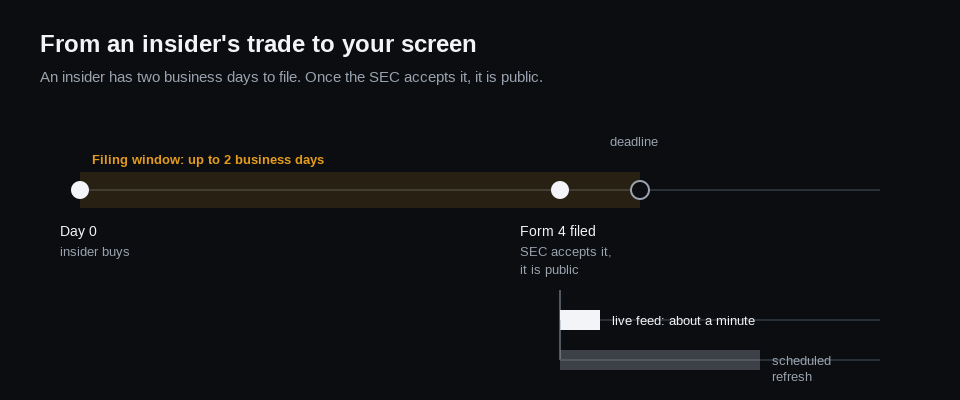
An insider screener lists the trades that a company's officers, directors and largest shareholders make in its own stock. Those trades are public because insiders have to report them to the SEC on Form 4 within two business days. A good insider screener shows open-market buys and sells as soon as they are filed, and lets you filter out the trades that say little, such as stock grants and option exercises.
This post explains where the data comes from, which insider trades are worth your attention, how to filter them, and how to watch them live.
What counts as an insider?
For reporting purposes, an insider is one of three kinds of people:
- Officers, such as the CEO, CFO and other senior executives.
- Directors on the company's board.
- Owners of more than 10% of a class of the company's shares.
These are the people covered by Section 16 of the Securities Exchange Act. When one of them buys or sells the company's stock, they file a Form 4.
What is a Form 4?
A Form 4 is the SEC filing that reports a change in an insider's holdings. It lists who traded, their role, the date, the number of shares, the price, and a transaction code that says what kind of trade it was. It has to be filed within two business days of the trade, and it becomes public on the SEC's EDGAR system as soon as the SEC accepts it.
Which insider trades matter?
Most Form 4 filings are not decisions to buy or sell. The transaction code tells you which ones are:
| Code | What it means | Does it tell you much? |
|---|---|---|
| P | Open-market or private purchase | Yes. The insider chose to spend their own money |
| S | Open-market or private sale | Sometimes. People sell for many reasons |
| A | Grant or award from the company | Rarely. It is pay, not a decision to buy |
| M | Exercise of an option or other derivative | Rarely on its own |
| F | Shares withheld to pay tax or an exercise price | No. It happens automatically |
| G | Gift | No |
That is why most traders who follow insiders start with code P. An insider can sell to pay taxes, buy a house or spread out their savings. There are fewer reasons to buy more of the company you already work for.
Sales still have a use. A sale that is large compared with what the insider owns, or several insiders selling in the same week, is different from one routine sale. Since 2023, the Form 4 also has a checkbox for trades made under a 10b5-1 plan, which is a trading schedule the insider set up in advance. A planned sale says less than an unplanned one.
How do you filter insider trades?
These are the filters that separate the trades worth reading from the rest:
- Transaction type. Purchases (P) and sales (S) only.
- Value. A minimum dollar value, for example $100,000 or $1 million, removes small trades that mean little for a large company.
- Role. A CEO or CFO buying usually carries more weight than a 10% holder adjusting a position.
- Clusters. Several different insiders buying the same stock within a few weeks is a stronger sign than one buyer.
- Your own list. Insider buying in a stock you already watch is more useful than a buy in a company you know nothing about.
Free sites that list Form 4 filings let you sort by most of these. What changes between tools is how quickly a new filing appears and whether you have to keep checking.
Does speed matter for insider trades?
Less than for price, but it can. An insider buy is a piece of news. A large purchase by a CEO can move a stock in the minutes after the filing becomes public, especially a small company or one that has been falling. A list you check once a day shows you that filing after the move. A live feed shows it when it is filed.
The same idea runs through our post on the difference between a stock screener and a stock scanner: one tells you what matched when you asked, the other tells you when something starts to match.
How to watch insider trades in Fastur
Fastur has an Insider Feed widget. Type INS in the command terminal to open it. It is a live list of open-market insider trades across the market, updated as Form 4 filings are accepted by the SEC.
- It shows only codes P and S, so grants, exercises, tax withholding and gifts are left out.
- You can choose Both, Buys or Sells, and a minimum value of $100K, $1M or $10M.
- You can limit it to your watchlists instead of the whole market.
- Each row shows the time the filing became public, the ticker, the insider's name and role, shares, price, value and a link to the filing on sec.gov.
- Clicking a row sends its ticker to a linked chart, so you can see what the stock is doing.
For one company's full insider history, including the other transaction codes, the Ownership widget shows every filing. The Insider Feed docs and Ownership docs cover both in detail.
How traders use insider buying
Insider buying is rarely a trade on its own. Traders use it as context:
- On a watchlist. A stock you already follow gets an insider buy, so you look at it again.
- With price action. An insider buy in a stock holding above a level you care about is a different picture from one in a stock still falling. Our scan guides cover the levels most traders watch.
- Before the open. Filings that arrived after the close and overnight are part of a pre-market routine.
The takeaway
An insider screener is only as useful as its filters. Start with open-market purchases, set a minimum value, weigh who is buying and look for more than one buyer. Then decide how quickly you need to know. If a filing is something you read the next day, a free list is enough. If you want to see it while the stock is still reacting, you need a live feed.
This post explains how insider filings work. It is not investment advice.
